Dresses Old Fashioned Blue White Floral
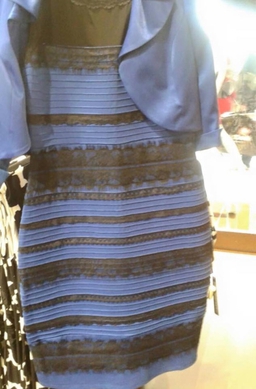
The original photograph
The wearing apparel is a photograph that became a viral phenomenon on the Net in 2015. Viewers of the image disagreed on whether the dress depicted was coloured black and blue, or white and gilt. The phenomenon revealed differences in homo colour perception, which have been the subject of ongoing scientific investigations into neuroscience and vision science, producing a number of papers published in peer-reviewed scientific journals.
The miracle originated from a washed-out colour photo of a apparel posted on the social networking service Facebook. Within a week, more than than ten million tweets had mentioned the clothes, using hashtags such as #thedress, #whiteandgold, and #blackandblue. Although the apparel was eventually confirmed to be coloured black and blue,[one] [ii] the epitome prompted much online word of different users' perceptions of the colour of the dress. Members of the scientific community began to investigate the photo for new insights into homo colour vision.
The dress was identified as a production of the retailer Roman Originals, which experienced a major surge in sales of the wearing apparel as a result of the incident. The retailer produced a one-off version of the wearing apparel in white and aureate as role of a charity campaign.
Origin
About a week before the wedding of couple Grace and Keir Johnston of Colonsay, Scotland, the bride's female parent, Cecilia Bleasdale, took a photograph of a clothes at Cheshire Oaks Designer Outlet due north of Chester, England, that she planned to habiliment to the wedding and sent it to her daughter.[iii] After disagreements over the perceived colour of the dress in the photograph, the helpmate posted the image on Facebook, and her friends also disagreed over the colour; some saw it as white with gold lace, while others saw information technology equally blue with black lace.[4] [5] For a week, the debate became well known in Colonsay, a small island community.[6]
On the day of the wedding, Caitlin McNeill, a friend of the bride and groom and a member of the Scottish folk music grouping Canach,[7] performed with her band at the wedding on Colonsay. Fifty-fifty after seeing that the dress was "obviously blue and black" in real life,[5] the musicians remained preoccupied past the photo; they said they well-nigh failed to make it on phase because they were caught up discussing the wearing apparel. A few days subsequently, on 26 February, McNeill reposted the image to her weblog on Tumblr and posed the same question to her followers, which led to farther public discussion surrounding the epitome.[4] [5]
Response
Initial viral spread
The most interesting thing to me is that it traveled. It went from New York media circle-jerk Twitter to international. And you could see it in my Twitter notifications considering people started having conversations in, like, Spanish and Portuguese and and so Japanese and Chinese and Thai and Arabic. It was amazing to watch this motion from a local thing to, like, a massive international miracle.'[8]
– Cates Holderness
Cates Holderness, who ran the Tumblr folio for BuzzFeed at the site's New York offices, noted a message from McNeill asking for the site'south help in resolving the colour dispute of the dress. At the time she dismissed it, simply then checked the page virtually the finish of her workday and saw that it had received around v,000 notes in that time, which she said "is insanely viral [for Tumblr]". Tom Christ, Tumblr's director of data, said at its height the folio was getting xiv,000 views a second (or 840,000 views per minute), well over the normal rates for content on the site. By afterwards that night, the number of total notes had increased tenfold.[eight]
Holderness showed the picture to other members of the site'due south social media team, who immediately began arguing about the dress's colours among themselves. After creating a simple poll for users of the site, she left piece of work and took the subway dorsum to her Brooklyn home. When she got off the train and checked her telephone, information technology was overwhelmed by the messages on various sites. "I couldn't open Twitter because it kept crashing. I thought somebody had died, possibly. I didn't know what was going on." Later in the evening the folio gear up a new tape at BuzzFeed for concurrent visitors, which would reach 673,000 at its peak.[8] [nine]
The viral prototype became a worldwide Internet meme across social media. On Twitter, users created the hashtags "#whiteandgold," "#blueandblack," and "#dressgate" to talk over their opinions on what the colour of the apparel was, and theories surrounding their arguments.[10] The number of tweets about the dress increased throughout the dark; at 11:36 pm GMT, when the first increment in the number of tweets about the dress occurred, there were five thousand tweets per minute using the hashtag "#TheDress," increasing to xi,000 tweets per infinitesimal with the hashtag by 1:31 am GMT.[eight] The photo also attracted word relating to the triviality of the matter every bit a whole; The Washington Post described the dispute every bit "[the] drama that divided a planet".[4] [11] [12] Some articles humorously suggested that the clothes could prompt an "existential crisis" over the nature of sight and reality, or that the debate could harm interpersonal relationships.[4] [thirteen] Others examined why people were making such a large statement over a seemingly little matter.[14]
Overnight popularity
That evening, Wellesley College neuroscientist Bevil Conway gave some comments on the phenomenon to Wired reporter Adam Rogers. Before they hung up, Rogers warned him, "your tomorrow will not be the same". Conway idea the reporter was exaggerating, saying, "I didn't appreciate the full extent of what was most to happen. Not even close." Rogers's story somewhen got 32.viii meg unique visitors. Meanwhile, when Conway woke upwards the next forenoon, his inbox had then many emails well-nigh the dress that at first, he idea his email had been hacked, until he saw that the majority were interview requests from major media organisations. "I did 10 interviews and had to have a colleague take my class that twenty-four hour period," said Conway.[8]
Celebrities with larger Twitter followings began to weigh in overnight. Taylor Swift's tweet—which described how while she saw information technology as blue and black, the whole affair left her "confused and scared"—was retweeted 111,134 times and liked 154,188 times.[viii] Jaden Smith, Frankie Muniz, Demi Lovato, Mindy Kaling, and Justin Bieber agreed that the dress was blueish and black, while Anna Kendrick, B. J. Novak, Katy Perry, Julianne Moore, and Sarah Hyland saw information technology equally white and gilded.[xv] Kim Kardashian tweeted that she saw it as white and gold, while her husband Kanye West saw it as bluish and black. Lucy Hale, Phoebe Tonkin, and Katie Nolan saw different colour schemes at different times. Lady Gaga described the dress as "periwinkle and sand," while David Duchovny called it teal. Other celebrities, including Ellen DeGeneres and Ariana Grande, mentioned the dress on social media without mentioning specific colours.[16] [7] [17] [18] [19] Politicians, government agencies and social media platforms of well-known brands also weighed in natural language-in-cheek on the issue.[20] Ultimately, the dress was the discipline of 4.four 1000000 tweets within 24 hours.[8]
The dress was designed and manufactured by Roman Originals.[21] In the UK, where the phenomenon had begun, Ian Johnson, creative director for Roman Originals, learned of the controversy from his Facebook news feed that morn. "I was pretty gobsmacked. I merely laughed and told the married woman that I'd better become to work," he said.[8] Telly presenter Alex Jones wore the clothes on that night's edition of The 1 Show.[22]
We've seen other stories go viral, but the sheer diversity of outlets that picked it up and were talking near information technology was unlike anything nosotros had always seen. Everyone from QVC to Warner Bros. to local public libraries to Reddish Cross affiliates were all posting links to it on their social accounts. That kind of diversity in who's sharing a story pretty much never happens...and certainly never to that degree. Even in the yr since and with a million different people trying to replicate it, nix has come up shut.[8]
Brandon Silverman, CEO of social media monitoring site CrowdTangle
Businesses that had cipher to do with the apparel, or even the article of clothing manufacture, devoted social media attention to the phenomenon. Adobe retweeted some other Twitter user who had used some of the company's apps to isolate the wearing apparel's colours. "We jumped in the conversation and thought, Let's see what happens," recalled Karen Practice, the company's senior manager for social media. Jenna Bromberg, senior digital brand director for Pizza Hut, saw the wearing apparel as white and gilded and quickly sent out a tweet with a picture show of pizza noting that information technology, too, was the same colours. Do called it "literally a tweet heard around the world".[8]
Ben Fischer of the New York Business organization Periodical reported that involvement in the first BuzzFeed article about the dress exhibited vertical growth instead of the typical bell curve of a viral phenomenon, leading BuzzFeed to assign 2 editorial teams to generate additional articles about the dress to drive advertizement revenue,[23] and by 1 March, the original BuzzFeed commodity had received over 37 one thousand thousand views.[24] The dress was cited past CNN commentator Mel Robbins as a viral phenomenon having the requisite qualities of positivity bias incorporating "awe, laughter and amusement," and was compared to and contrasted with the llama chase earlier that mean solar day, too as to tributes paid to histrion Leonard Nimoy after his death the following twenty-four hours.[25]
Real colours of dress confirmed
The dress itself was confirmed equally a royal blueish "Lace Bodycon Clothes" from the retailer Roman Originals,[26] which was actually black and blueish in colour;[i] [ii] although available in three other colours (red, pink, and ivory, each with black lace), a white and gilt version was non available at the fourth dimension. The day later on McNeill'due south postal service, Roman Originals' website experienced a major surge in traffic; a representative of the retailer stated that "we sold out of the apparel in the first 30 minutes of our business twenty-four hours and after restocking it, information technology's become phenomenal".[27] On 28 February, Roman announced that they would make a unmarried white and gold dress for a Comic Relief charity auction.[28]
On three March, the Johnstons, Bleasdale, and MacNeill appeared as guests on The Ellen DeGeneres Show in the U.s.a.. After revealing that she sees the apparel every bit white and gold, DeGeneres presented each of them with gifts of underwear patterned after the clothes only combining both colour schemes, and evidence sponsors likewise gave the Johnstons a gift of $ten,000 and a honeymoon trip to Grenada, as they had left their honeymoon early to participate in the show.[vi]
By 1 March, over two-thirds of BuzzFeed users polled responded that the dress was white and aureate.[29] Some people have suggested that the wearing apparel changes colours on its ain.[four] Media outlets noted that the photograph was overexposed and had poor white residue, causing its colours to exist washed out, giving ascent to the perception by some that the dress is white and gold rather than its actual colours.[4] [30]
Scientific explanations

Two ways in which the photograph of The dress may be perceived:
- blue and blackness under a yellow-tinted illumination (left figure) or
- white and golden under a blue-tinted illumination (correct figure).
There is currently no consensus on why the dress elicits such discordant color perceptions among viewers,[31] though these have been confirmed and characterised in controlled experiments (described below). No synthetic stimuli have been constructed that are able to replicate the effect as clearly as the original image.
Neuroscientists Bevil Conway and Jay Neitz believe that the differences in opinions are a result of how the human encephalon perceives colour, and chromatic adaptation. Conway believes that it has a connection to how the brain processes the various hues of a daylight sky: "Your visual system is looking at this matter, and you're trying to discount the chromatic bias of the daylight axis... people either disbelieve the blue side, in which instance they end upwards seeing white and gold, or discount the gold side, in which example they terminate upward with blue and black."[32] [33] Neitz said:
Our visual system is supposed to throw abroad information nigh the illuminant and extract information nigh the bodily reflectance... just I've studied private differences in colour vision for 30 years, and this is i of the biggest private differences I've always seen.[32]
Similar theories have been expounded by the University of Liverpool'south Paul Knox, who stated that what the encephalon interprets as colour may be affected by the device the photograph is viewed on, or the viewer'south own expectations.[34] Anya Hurlbert and collaborators also considered the problem from the perspective of colour perception. They attributed the differences in perception to individual perception of color constancy.[35] [36]

Neuroscientist and psychologist Pascal Wallisch states that while inherently ambiguous stimuli have been known to vision scientific discipline for many years, this is the beginning such stimulus in the colour domain that was brought to the attending of science by social media. He attributes differential perceptions to differences in illumination and textile priors, but also notes that the stimulus is highly unusual insofar as the perception of most people does not switch. If information technology does, it does so only on very long time scales, which is highly unusual for bistable stimuli, and so perceptual learning might be at play.[37] In addition, he says that discussions of this stimulus are not frivolous, as the stimulus is both of involvement to scientific discipline and a paradigmatic case of how unlike people can sincerely see the globe differently.[38] Daniel Hardiman-McCartney of the Higher of Optometrists stated that the movie was ambiguous, suggesting that the illusion was caused past a strong yellowish lite shining onto the dress, and human perception of the colours of the dress and light source by comparison them with other colours and objects in the picture.[39] The philosopher Barry C. Smith compared the phenomenon with Ludwig Wittgenstein and the rabbit–duck illusion,[40] although the rabbit-duck illusion is an ambiguous epitome where, for most people, the alternative perceptions switch very hands.
The Journal of Vision, a scientific periodical about vision enquiry, announced in March 2015 that a special event about the dress would exist published with the title A Dress Rehearsal for Vision Scientific discipline.[41] [42] The first large-scale scientific written report on the clothes was published in Electric current Biology iii months afterward the epitome went viral. The study, which involved one,400 respondents, found that 57% saw the dress equally blue and blackness, 30% saw it as white and golden, xi% saw it every bit blue and brown, and two% reported it as "other".[43] Women and older people disproportionately saw the dress as white and aureate. The researchers farther found that if the dress was shown in artificial yellowish-coloured lighting almost all respondents saw the wearing apparel every bit black and blueish, while they saw information technology as white and golden if the simulated lighting had a blue bias.[33] [43] [44] [45] Some other study in the Journal of Vision, by Pascal Wallisch, found that people who were early risers were more likely to think the dress was lit by natural light, perceiving information technology equally white and gilt, and that "dark owls" saw the dress as blue and black.[46] [47]
A study carried out by Schlaffke et al. reported that individuals who saw the wearing apparel as white and golden showed increased activity in the frontal and parietal regions of the brain. These areas are idea to be disquisitional in loftier cognition activities such every bit top-down modulation in visual perception.[48] [49]
Legacy
The dress was included on multiple year-end lists of notable cyberspace memes in 2015.[50] [51] As the original authors of the photo that sparked the viral phenomenon, Bleasdale and her partner Paul Jinks after expressed frustration and regret over being "completely left out from the story", including their lack of control over the story, the omission of their role in the discovery, and the commercial apply of the photograph.[nine] In South Africa, the Salvation Army attempted to re-straight some of the mass awareness generated by the dress towards the event of domestic violence.[52] Additionally, the retailer of the apparel produced a one-off version of the dress in white and gilt for clemency.[53]
See too
- Checker shadow illusion
- Police of triviality
- List of Net phenomena
- Yanny or Laurel
- List of dresses
References
- ^ a b "The blue and blackness (or white and golden) dress: Actual colour, brand, and cost details revealed". The Independent. 27 February 2015. Archived from the original on 13 July 2019. Retrieved 10 May 2015.
- ^ a b "Optical illusion: Clothes color debate goes global". BBC News. BBC. Archived from the original on thirteen July 2019. Retrieved 28 February 2015.
- ^ Benedictus, Leo (22 December 2015). "#Thedress: 'It's been quite stressful having to deal with information technology ... nosotros had a falling-out'". The Guardian. Archived from the original on 11 Dec 2019. Retrieved 11 December 2019.
- ^ a b c d e f "The inside story of the 'white dress, blueish dress' drama that divided a planet". The Washington Postal service. Archived from the original on 12 July 2018. Retrieved 27 February 2015.
- ^ a b c "The Dress Is Blue And Black, Says The Girl Who Saw It in Person". BuzzFeed. Archived from the original on xxx May 2018. Retrieved 27 February 2015.
- ^ a b "Ellen DeGeneres Settles the Neat Dress Debate Once and For All!". Amusement This night. Archived from the original on xxx March 2016. Retrieved twenty March 2016.
- ^ a b Iyengar, Rishi. "The Dress That Broke the Internet, and the Woman Who Started It All". Archived from the original on xvi October 2017. Retrieved 27 February 2015.
- ^ a b c d eastward f g h i j Warzel, Charlie (26 Feb 2015). "2/26: The Oral History". BuzzFeed. Archived from the original on 19 March 2018. Retrieved 28 February 2016.
- ^ a b "#TheDress couple: 'we were completely left out from the story'". BBC News. i January 2016. Archived from the original on six Jan 2016. Retrieved 28 January 2016.
- ^ Klassen, Anna (26 February 2015). "What Colors Are This Clothes? White & Gold or Black & Blue? The Internet Is Going Insane Trying To Detect Out – PHOTO". Bustle. Archived from the original on 21 August 2017. Retrieved 27 February 2015.
- ^ "Color Demark: This Dress is White and Gilded, Right?". Boston Globe. Archived from the original on five March 2016. Retrieved 27 Feb 2015.
- ^ "The Official Live Blog: Is This Dress Blue and Blackness or White and Gold?". Slate. 27 February 2015. Archived from the original on 15 October 2018. Retrieved 27 Feb 2015.
- ^ Rex, Kirsten (26 Feb 2015). "This Dress Is Ruining People'southward Lives". BuzzFeed. Archived from the original on 30 May 2018. Retrieved i March 2015.
- ^ "Why do we care about the colour of the dress?". The Guardian. 27 February 2015. Archived from the original on 21 Baronial 2017. Retrieved 28 May 2015.
- ^ "What Colors Are This Apparel? Kim Kardashian, Miley Cyrus, Justin Bieber and a Bajillion Other Celebs Weigh In". MTV News. Archived from the original on 1 April 2015. Retrieved thirty March 2015.
- ^ "#Dressgate: The white and gold apparel making our mind work until it'due south black and blue". The Sydney Morning Herald. 27 February 2015. Archived from the original on 26 Baronial 2017. Retrieved 27 February 2015.
- ^ Sanchez, Josh (26 February 2015). "'What colour is this clothes' confused celebrities, too". Fansided.com. Archived from the original on 27 February 2015. Retrieved 27 February 2015.
- ^ Mahler, Jonathan. "A White and Golden Dress Overloads the Internet". The New York Times. Archived from the original on xviii May 2018. Retrieved 27 February 2015.
- ^ Iyengar, Rishi (26 February 2015). "Taylor Swift Says The Dress is Blackness and Bluish". Time. Archived from the original on thirteen September 2017. Retrieved 1 March 2015.
- ^ Jim Dalrymple Ii. "Politicians, Police, And Brands Have Weighed in On "The Dress"". Buzzfeed.com. Archived from the original on twenty November 2017. Retrieved 6 March 2015.
- ^ Grant, Katie (30 October 2015). "The Apparel: Roman Originals co-founder Peter Christodoulou on how viral paradigm left company sitting pretty". The Independent. Archived from the original on 21 May 2018. Retrieved twenty May 2018.
- ^ Forrester, Katy (28 Feb 2015). "Watch Alex Jones stone #TheDress on The Ane Prove as debate rumbles on over its colour". Daily Record . Retrieved 25 August 2021.
{{cite web}}: CS1 maint: url-status (link) - ^ Fischer, Ben (27 Feb 2015). "The Apparel phenomenon didn't happen by accident. Information technology took big money". New York Business Journal. American City Business Journals. Archived from the original on 6 March 2017. Retrieved 1 March 2015.
- ^ Holderness, Cates (26 February 2015). "What Colors Are This Wearing apparel?". BuzzFeed. Archived from the original on 23 Apr 2018. Retrieved 1 March 2015.
- ^ Robbins, Mel (28 February 2015). "Why blueish/blackness/white/aureate dress went viral". CNN. Archived from the original on xvi May 2018. Retrieved iii March 2015.
- ^ "Lace Detail Bodycon Dress". Archived from the original on 27 February 2015. Retrieved 27 February 2015.
- ^ "'The Dress' flying off racks following Cyberspace awareness: 'We sold out in the first 30 minutes of our business organization day'". Daily News. New York. Archived from the original on 21 May 2018. Retrieved 27 Feb 2015.
- ^ "'The Apparel' returns in special edition gold and white version for Comic Relief charity sale". The Independent. 10 March 2015. Archived from the original on 29 September 2017. Retrieved 10 March 2015.
- ^ Holderness, Cates (26 February 2015). "What Colors Are This Apparel?". Buzzfeed. Archived from the original on 23 April 2018. Retrieved 1 March 2015.
- ^ "Why that dress looks white and gold: It'due south overexposed". Mashable. Archived from the original on 20 April 2018. Retrieved 27 February 2015.
- ^ González Martín-Moro, J.; Prieto Garrido, F.; Gómez Sanz, F.; Fuentes Vega, I.; Castro Rebollo, M.; Moreno Martín, P. (April 2018). "Which are the colours of the dress? Review of an atypical optic illusion". Archivos de la Sociedad Española de Oftalmología (English language Edition). 93 (four): 186–192. doi:10.1016/j.oftale.2018.02.003.
- ^ a b "The Science of Why No One Agrees on the Color of This Wearing apparel". Wired. 27 February 2015. Archived from the original on 28 February 2015. Retrieved 27 February 2015.
- ^ a b Sample, Ian (xiv May 2015). "#TheDress: have researchers solved the mystery of its colour?". The Guardian. Archived from the original on 28 Nov 2016. Retrieved xiii December 2016.
- ^ "Viewpoint: Blueish and black or white and gilt?". News.liv.ac.uk. Archived from the original on two March 2015. Retrieved 27 Feb 2015.
- ^ Hurlbert, Anya; Aston, Stacey (2017). "What #theDress reveals about the role of illumination priors in color perception and colour constancy". Journal of Vision. 17 (seven): 4. doi:10.1167/17.nine.four. PMC5812438. PMID 28793353. Archived from the original on 13 August 2020. Retrieved 25 Baronial 2020.
- ^ Brainard, DH; Hulbert, A (2015). "Colour Vision: Understanding #TheDress". Current Biology. 25 (13): R551–R554. doi:10.1016/j.cub.2015.05.020. PMID 26126278. Archived from the original on 4 Dec 2020. Retrieved 25 August 2020.
- ^ "An experts lesson from the dress". Slate. two March 2015. Archived from the original on 20 Apr 2018. Retrieved 6 March 2015.
- ^ "Why discussing the apparel is not frivolous". pascallisch.internet. two March 2015. Archived from the original on 3 March 2015. Retrieved vi March 2015.
- ^ Hardiman-McCartney, Daniel (2 March 2015). "#Thedress and your optometrist – the scientific vocalization of reason". College of Optometrists. Archived from the original on vii March 2017. Retrieved half-dozen March 2017.
- ^ "What would Wittgenstein say almost that clothes?". BBC. 27 Feb 2015. Archived from the original on nine March 2015. Retrieved 6 March 2015.
- ^ "Journal of Vision – Special Issue on The Wearing apparel". 12 March 2015. Archived from the original on nine May 2015. Retrieved ten May 2015.
- ^ "- JOV - ARVO Journals - JOV - ARVO Journals". jov.arvojournals.org. Archived from the original on ane April 2018. Retrieved 1 April 2018.
- ^ a b Lafer-Sousa, Rosa; Hermann, Katherine L.; Conway, Bevil R. (29 June 2015). "Striking individual differences in color perception uncovered by 'the dress' photo". Current Biology. 25 (13): R545–R546. doi:10.1016/j.cub.2015.04.053. PMC4921196. PMID 25981795.
- ^ Gegenfurtner, Karl R.; Bloj, Marina; Toscani, Matteo (29 June 2015). "The many colours of 'the dress'". Current Biology. 25 (13): R543–R544. doi:10.1016/j.cub.2015.04.043. PMID 25981790.
- ^ Winkler, Alissa D.; Spillmann, Lothar; Werner, John S.; Webster, Michael A. (29 June 2015). "Asymmetries in blue–yellowish colour perception and in the colour of 'the dress'". Electric current Biology. 25 (13): R547–R548. doi:10.1016/j.cub.2015.05.004. PMC4489998. PMID 25981792.
- ^ Wallisch, Pascal (7 April 2017). "Illumination assumptions account for individual differences in the perceptual interpretation of a profoundly ambiguous stimulus in the color domain: "The dress"". Periodical of Vision. 17 (4): five. doi:x.1167/17.4.5. PMID 28388701.
- ^ Wallisch, Pascal (12 April 2017). "Two Years Afterward, We Finally Know Why People Saw "The Wearing apparel" Differently". Slate. Archived from the original on 16 January 2018. Retrieved 3 March 2018.
- ^ Knapton, Sarah (15 March 2016). "Dressgate: If you saw THAT dress every bit white your brain was working overtime". The Telegraph. Archived from the original on 2 Apr 2018. Retrieved 1 Apr 2018.
- ^ Schlaffke, Lara (Dec 2015). "The brain's wearing apparel code: How The Dress allows to decode the neuronal pathway of an optical illusion". Cortex. 73: 271–275. doi:10.1016/j.cortex.2015.08.017. PMID 26478963. S2CID 25188324.
- ^ "The xv Best Memes of 2015". Entertainment Weekly'south EW.com. Archived from the original on 14 March 2016. Retrieved 20 March 2016.
- ^ "24 Memes That Took The Internet Past Storm in 2015". MTV News. Archived from the original on 2 Apr 2016. Retrieved 20 March 2016.
- ^ "Salvation Army uses The Dress in ad targeting violence against women". CBC News. half-dozen March 2015. Archived from the original on 2 Feb 2018. Retrieved 25 March 2015.
- ^ "'The Dress' returns in special edition gold and white version for Comic Relief charity auction". The Independent. 10 March 2015. Archived from the original on 29 September 2017. Retrieved ten March 2015.
External links
 | Wikimedia Commons has media related to The wearing apparel. |
- "Original Tumblr postal service". Archived from the original on 27 Feb 2015. Retrieved 29 February 2016. (as of 27 February 2015 at 01:49:59 UTC)
- "We tin confirm #TheDress is blue and black! We should know!". Twitter. @romanoriginals. Archived from the original on 4 March 2020. Retrieved 4 April 2020.
0 Response to "Dresses Old Fashioned Blue White Floral"
Post a Comment